Signaling
Showdown
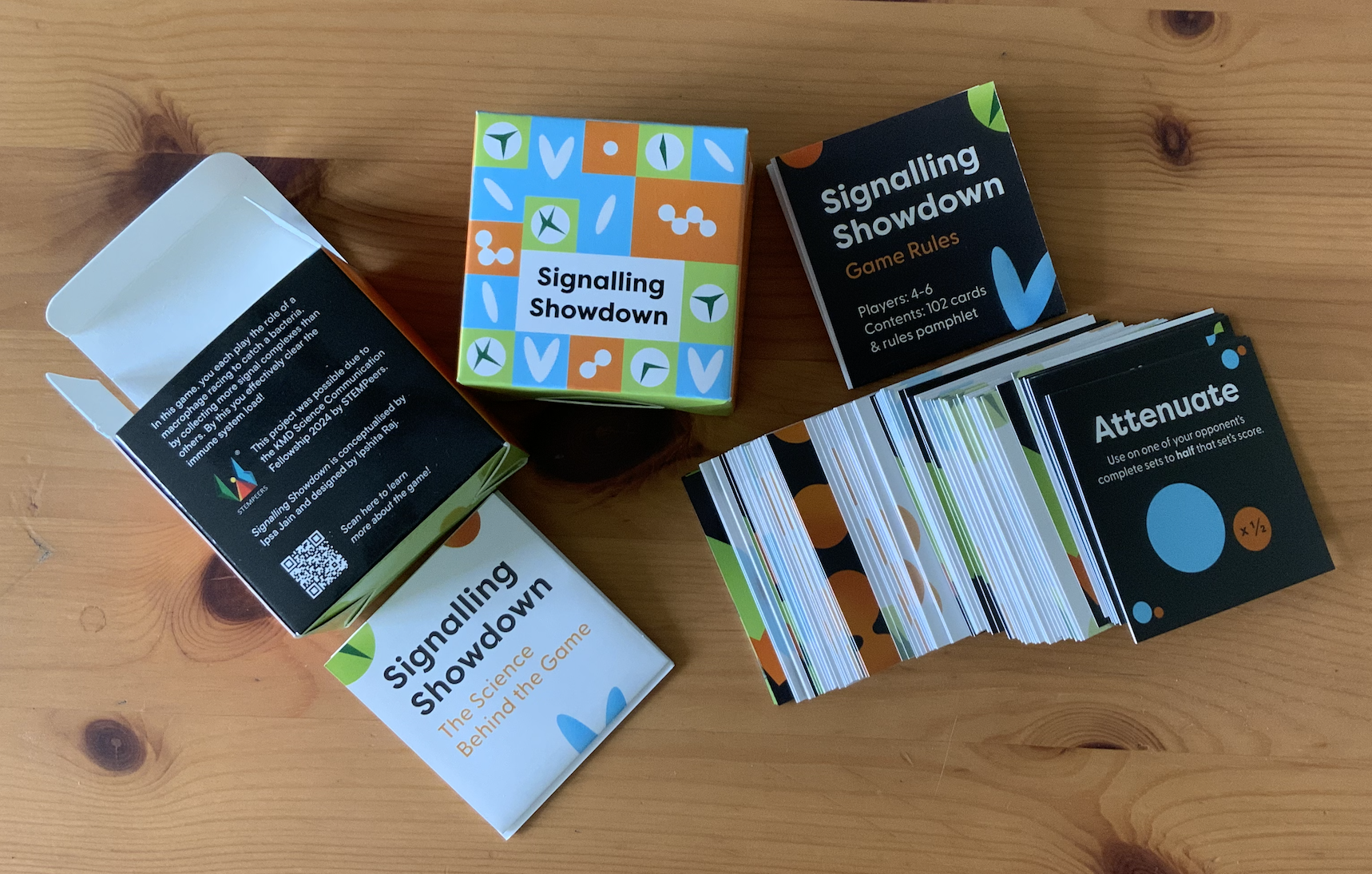
A 4–6 player card game about signal transduction. Each player is a macrophage racing to catch bacteria by building molecular signal complexes faster than every other player/macrophage. And, yes! macrophages cooperate and still race with each other to catch the forgien body.
STEMPeers · Supported by grant
Catch the bacteria.
Build the signal.
In Signaling Showdown, each player takes on the role of a macrophage, an immune cell, racing to capture bacteria by assembling the right molecular signal complexes. The game mirrors how cells actually sense and respond to their environments. They receive a signal, interpret it, and mount a response.
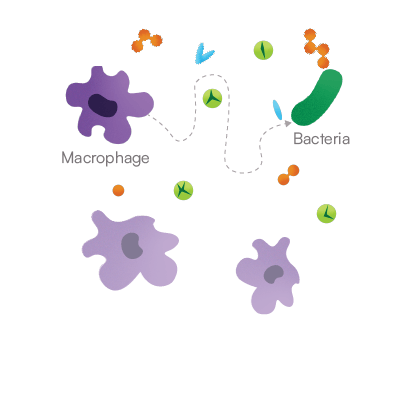
Every signal in the game requires specific components to be complete: a sensory receptor (R), an amplifier enzyme (E), and an effector protein (P). Collect the most number of sets, and score more than your opponents. Use regulatory and action cards wisely to tip the balance.
The game is designed for 4–6 players and is suitable for high school students, undergraduates, science enthusiasts, and anyone curious about cell biology or also friends on a Saturday card game night.
Collect. Build. Win.
Each player races to assemble complete molecular signal complexes — collecting the right receptor, enzyme, and effector cards before anyone else does. Use regulatory and action cards to boost your score or disrupt your opponents. The cell with the most complete signals wins. Full rules are in the downloadable rulebook.
Set Up
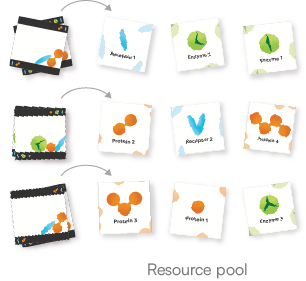
Lay out the shared card pool from the deck and decide who goes first. Everyone can see everyone’s cards, just like cells communicating with each other.
Take Turns
On each turn, pick cards from the pool to start building your signal sets.
Score & Win
When no more signals can be completed, tally your points. The more complex your signals, the higher your score. The winning macrophage clears the field!

Game Instructions, watch with instruction pamphlet. 1.5x speed recommended.
“I wanted to make a game that leans more towards fun and replayability than giving a lecture.”
How this game came to be
The seed was planted by a ex-colleague, Shraddha Jain when she mentioned games that could be both informative and genuinely fun. As a science communicator, I found myself noticing a gap: most science card games, barring a few exceptions, tend to be education-first, with replayability and the sheer joy of play as afterthoughts.
That observation became a challenge I wanted to take on. Could you make a science game that people actually want to play again? One that doesn’t feel like a lecture with cardboard? That tension between scientific rigour and real fun has been the hardest thing to get right. But I think Signaling Showdown has made genuine progress in that direction.
The choice of signal transduction as the topic was deliberate. Most science games gravitate toward familiar cellular processes like cell division or photosynthesis. I wanted to go a scale smaller, into molecular processes that rarely make it into the public imagination. Signal transduction has everything a game needs: many steps, specificity, and also beautiful qualities like plasticity and modularity that translate naturally into interesting mechanics.
Playtesting with non-scientists was revelatory. Early versions tried to encode too much like sepcific game playes for each mechanism. What players actually connected with was the bigger idea: that cells have feedback loops, that signals can be amplified or dampened, that context changes everything. Working with it made the game better.
Ipshita Raj joined the project as designer and became much more than that. When the game was stalling, she helped push it forward by organising playtesting sessions, collecting feedback from her own networks, and bringing a designer’s eye that shaped the final deck in ways I couldn’t have alone. The game is very much a collaboration.


Download & Print
for free
Signaling Showdown is freely available for personal, educational, and non-commercial use. Download the files, print them at home or at a print shop, and start playing. Print front to back for card files and cut up individual cards with scissors.
Card Print Files
Print-ready PDF of all 102 cards, ready for home or professional printing.
↓ Download PDFWant printed copies for your classroom, lab, or event?
We can arrange professionally printed copies of Signaling Showdown for schools, universities, science festivals, workshops, and other educational settings.
If you need large number of copies (50+), get in touch and we’ll figure out the best way to make it work.
Please include your name, organisation, number of copies needed, and intended use. We’ll get back to you within a few days.